

By Yuri Iskhakov, Founder & CEO of NANO · Marketing Without Guesswork, Episode 1
If you can’t tell me what your marketing is supposed to deliver this year, it’s already failing. A marketing goal is a clear statement of the result marketing is responsible for — not a list of activities. Start with the business outcome you need, add what a win looks like for you as the founder, and write one sentence: “Marketing’s job this year is ___.” Every idea, hire, and dollar then gets one test: does it move that sentence?
Key takeaways
- A marketing goal is a finish line, not a to-do list. “Run LinkedIn ads” is a tactic; “three new $50K+ clients” is a goal.
- Start with the business goal, then name marketing’s part of it.
- Add a founder win so you don’t “succeed” in a way you can’t sustain.
- Collapse both into one sentence: “Marketing’s job this year is ___.”
- Test every new idea against that sentence. If it doesn’t move it, park it.
What is a marketing goal?
Definition. A marketing goal is the finish line marketing is accountable for in a set period of time, usually a year. It names a result you can recognize when it happens. “Launch LinkedIn ads” and “redo the website” are not goals. They are tactics. A goal sounds like: “Bring in three new clients above a set project size, without the founder personally chasing every lead.” (That sentence is an example, not a target to copy.)
If you cannot state that finish line, you can still tell whether you did the work. You cannot tell whether marketing did its job.
Why does starting with tactics leave marketing without a finish line?
Most founders I talk to do not have a marketing problem that starts with ads or the website. They have a finish-line problem.
The year begins with pressure to “do marketing,” so they start with tactics: post more, run LinkedIn ads, rebuild the site. Each of those can be useful. None of them tells you what “useful” means. Without a defined win, every idea sounds reasonable, and you keep paying for everything. At the end of the quarter you have activity — and no honest answer to the only question that matters: did marketing do its job?
I’ve built growth for companies at NANO since 2007. This is the most common pattern I see, and the easiest to fix. The fix is a sentence, not a bigger budget.
How do you set a marketing goal that actually guides decisions?
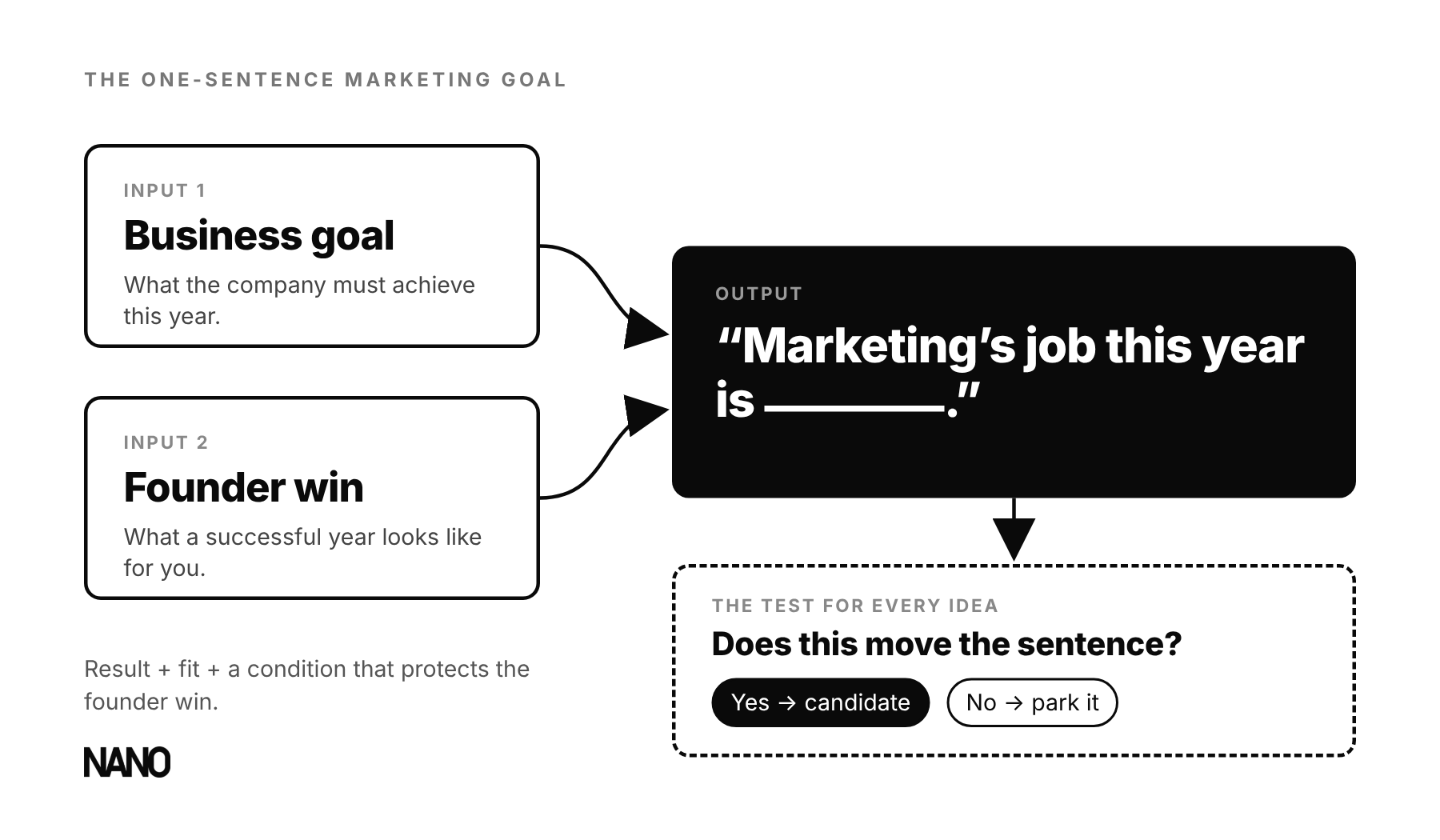
1. Start with the business goal, not the channel
Ask what the business must do this year, and be concrete: grow revenue (or a specific line of work), improve margin, win larger or better-fit clients, prepare the company to sell, or get it ready to run without you in every deal.
Marketing does not own that entire goal. Pricing, delivery, and the product all matter. Marketing’s part is who you reach, how clearly you show up, and how many of the right people start a conversation. Write the business goal first. If it is vague (“grow,” “get more known”), sharpen it before you touch marketing.
2. Add the founder win
A plan that hits a number and burns you out is not a full win. Next to the business goal, write what a successful year looks like for you: time back, a reputation that brings inbound conversations, less reliance on you personally chasing every lead — or on referrals you cannot predict.
If new clients only arrive when you personally work a room, you do not have a marketing system. You have a founder who is still the entire channel. Put the founder win in the goal so you do not “succeed” in a way you cannot sustain.
3. Write one sentence: “Marketing’s job this year is ___”
Collapse both wins into a single sentence. Use this stem, and do not decorate it:
Marketing’s job this year is ________________________________.
A complete sentence usually has three parts:
- The result — what shows up.
- A qualifier for quality or fit — what kind of result counts.
- A condition that protects the founder win — how it should happen.
Example, not a target to copy: “Marketing’s job this year is to bring in three new $50K+ clients without me personally chasing every lead.” That is specific enough to say no. “Get more leads” is not.
4. Give every idea one test
When someone proposes a tactic — a podcast, a booth, a site redesign, a hire — ask one question: does this move the sentence? If yes, it is a candidate. If no, park it. You are not saying it is a bad idea forever. You are saying it is not this year’s job. That is how a finish line saves money: it gives you a fair reason to stop paying for work that is busy but not aimed.
What does a finished marketing goal look like in practice?
The company and numbers below are a worked example, not a NANO client result.
Maya runs a 15-person B2B services firm. She has approved a website refresh, a LinkedIn ads test, and a newsletter. Asked what marketing should deliver this year, she says “more visibility.” That is a wish, not a finish line.
Her real business goal is sharper: two large accounts will wrap in the next 18 months, and she needs to replace that work with clients of similar size. Her founder win: conversations that start without her chasing every one.
Her sentence: “Marketing’s job this year is to bring in three new $50K+ clients without me personally chasing every lead.”
Now the website has a job: help the right firms raise a hand. The ads have a job: put that offer in front of those firms — and get audited against that job, not against clicks. The newsletter has a job: stay useful to people who will not buy this quarter. An awards campaign that does not reach those buyers waits. By mid-year she can tell whether marketing is on track — not by counting posts, but by counting qualified conversations and clients that match the sentence.
What’s the fill-in template for your marketing goal?
Copy this and complete it in one sitting. If a line is still blank when you finish, that is the work.
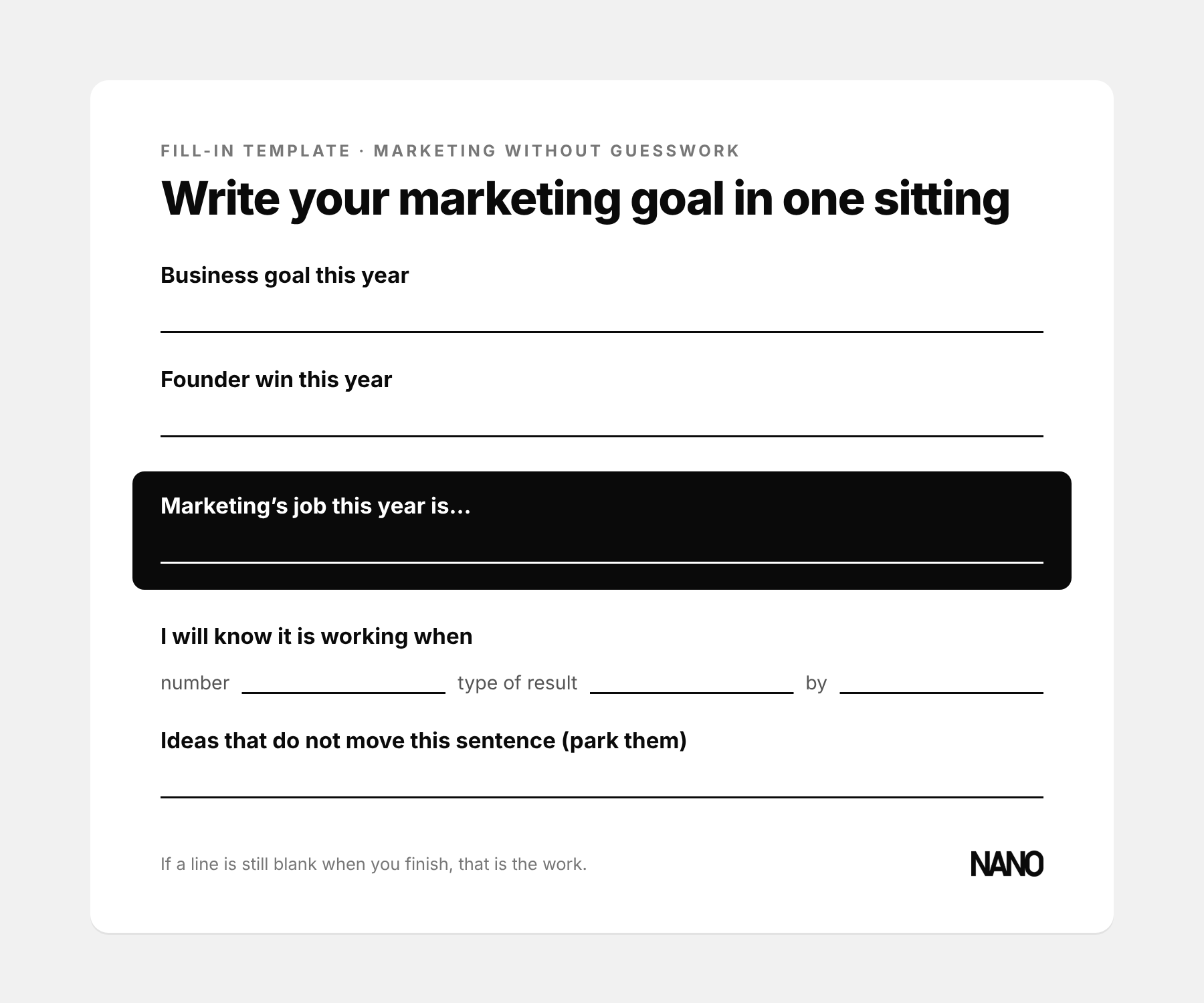
Business goal this year:
________________________________________________

Founder win this year:
________________________________________________

Marketing’s job this year is:
________________________________________________

I will know it is working when:
(number) ________ (type of result) ________ by (date) ________

Ideas that do not move this sentence (park them):
________________________________________________
Put the sentence at the top of your plan, on the weekly agenda, and in briefs you send other people. Then use it. A sentence sitting in a notes app is not a finish line.
What are the common mistakes when setting marketing goals?
- Starting with the tactic. “We need to be on LinkedIn” is a decision made backwards. Decide the job, then choose the channel.
- Goals you cannot recognize. “Build the brand” and “get more visibility” have no finish line. Rewrite them until a reasonable person could say, at year end, whether it happened.
- Handing marketing a company goal it cannot own alone. “Increase revenue 20%” is a business goal. Name marketing’s part: the conversations and qualified opportunities that feed it.
- Too many jobs. If marketing’s job is twelve things, it has no job. One sentence. Two at most, and only if they do not compete for the same time and budget.
- Confusing activity with the finish line. Posts, emails, and followers are useful to watch. They are not the goal. The goal is the result those activities are supposed to produce.
- Writing the sentence once and never using it. The test only works if you apply it when a new idea shows up, including your own.
Frequently asked questions
What is a marketing goal?
A marketing goal is a clear, time-bound statement of the result marketing is responsible for. It describes an outcome you can count or clearly recognize, not a list of activities.
How is a marketing goal different from a tactic?
A tactic is something you do: run ads, publish content, redesign a site. A goal is what those actions are for. If you cannot connect a tactic to the goal in one sentence, it does not belong in this year’s plan.
Should a marketing goal include revenue?
It can, if marketing’s influence on that revenue is clear — for example, a number of new clients at a stated project size. If revenue depends heavily on pricing, delivery, or a long sales cycle you do not control, state the result marketing can own, such as qualified conversations or proposals sent to the right kind of buyer.
How many marketing goals should I set for the year?
One is enough. Two is the ceiling. If you have five “priorities,” you have none.
What if I do not have last year’s numbers?
Write the sentence anyway, with the best estimate you have, and start tracking this week. A rough finish line you measure from today is more useful than waiting for perfect data.
What comes after the sentence?
Once the job is clear, you can set the strategy (the route) and the tactics (the work). That is the next piece of this series: how business goals, marketing goals, and tactics fit together, and why posting more is not a strategy.
Write your sentence, then get the plan on one page
This article is episode 1 of a 12-week series on building a marketing plan in public. The next step is to put your goal, your audience, and your channels on one page. Start with the template above — it takes one sitting.
If you want a second set of eyes, book a NANO marketing plan audit. We will review your sentence, your site, and your numbers, and tell you where the plan has a gap.
About the author. Yuri Iskhakov is the founder and CEO of NANO (Nano Web Group), a growth services, product engineering, and venture-building firm he started in 2007.